Local residents are a reservoir of varied creative and business skills that imbue small towns with new life.
This year’s Toucheng Art Festival was different from previous iterations and not just because it spilled out from its customary old street grounds to sprawl across the town. For the first time since the event’s inception, the organizer invited guest curators from outside the urban township in northeastern Taiwan’s Yilan County and tasked them with offering fresh perspectives on the performances and exhibitions of local artists and artisans.
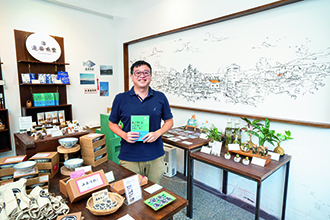
Goldfish Space founder Peng Ren-hong displays a book on the artisans and artists of Toucheng. (Photo by Chin Hung-hao)
“Look closely at this town and you’ll find that we have more than our fair share of inhabitants who are passionate about some specific skill, art form or cause,” said Peng Ren-hong (彭仁鴻), founder of the social enterprise Goldfish Space located on Toucheng’s old street. Named for the former magistrate whose home it now occupies, Goldfish Space received a government subsidy through a youth empowerment project from the National Development Council.
In addition to organizing the festival, Goldfish Space designs trips for visitors to explore the town, drawing on research that Peng undertook for a book on Toucheng’s hidden gems. The work profiles 38 individuals, from a skilled blacksmith on the old street to the leader of a beiguan troupe reviving the traditional musical genre. This year the two projects combined, with buses carrying festivalgoers to a selection of shops and studios featured in the book.
Hsiao Hsi-hsin (蕭錫鑫), chair of Lan-Yang Urban-Rural Aesthetics Foundation, is another local figure celebrated in the book for his organization’s role in ensuring the town’s environmental sustainability through planting trees, cleaning beaches and guarding wetlands from pollution. “Only when the environment is well protected can Toucheng truly have sustainable tourist development,” Hsiao said. His attitude is reflected in the green practices adopted at Hofi Villa, an upscale hotel he runs in the town that provides environmentally friendly toiletries and offers guests local specialties made with ingredients sourced from the area.
Hofi Villa, a peaceful retreat in Toucheng, promotes environmental sustainability by providing dishes made from locally sourced ingredients. (Photo by Chin Hung-hao)
Toucheng also attracts those from further afield: South African Anje Fan runs a wine bar by Taiwan Railways Administration’s Toucheng Station called The Thirsty Owl. The charming establishment opened in June and immediately lit up the township’s nightlife. “If you see a crowd on a Toucheng street in the evening, they’re probably headed to or from my bar,” Fan joked. During the day, she is just as busy: this autumn saw her help mount two exhibitions of art by immigrants like herself.
A poster for this year’s Daxi Wood Art and Life Festival held in the northern city of Taoyuan (Courtesy of Daxi Wood Art Ecomuseum)
Highlighting Handicrafts
A little over 50 kilometers to the west, Daxi Wood Art Ecomuseum (DWAE) is playing a pivotal role in breathing life back into its namesake township, which has been known since the 1820s as a center for wooden furniture. Established in 2015 as Taoyuan City’s only municipal museum and with a mission to manage a cluster of houses built primarily in the Japanese colonial period (1895-1945), DWAE is revitalizing the region by giving the renovated structures new life as exhibition spaces for subjects educational and entertaining alike. Daxi has given rise to both furniture makers and pop diva Fong Fei-fei (鳳飛飛), and while tourists are drawn to DWAE’s old granaries, police dormitories and assembly hall, the former police chief’s residence, which houses Fong memorabilia such as vinyl record covers and press articles, is especially popular.
To raise the town’s profile and facilitate exchanges between skilled local workers and outside artisans, the institution organized the first Daxi Wood Art and Life Festival this year with funding provided by the Ministry of Culture’s regional revitalization project. The event, which took place over nine days starting in late October and is planned for every other year going forward, included a forum on woodworking, a design competition and a fair for wares by international furniture makers. As part of the festivities, selected factories and studios were opened to the public for visitors to engage with the craft through hands-on experiences. “It’s a great opportunity for people to explore Daxi,” said Chen Chien-hui (陳倩慧), the museum’s director. “And local artisans can find inspiration for new designs, which further contributes to the town’s reputation as a wood furniture hub.”
Daxi Wood Art Ecomuseum presents exhibits on the town’s general history in a restored building that was once a police dormitory. (Photo by Chin Hung-hao)
Key to DWAE’s regional revitalization project is promoting the concept that the whole town forms a museum. To that end, it has developed a network of distinctive private establishments across Daxi whose operators are keen to share their stories with the public. Each of these entities, which range from old shops and restaurants to farms and temples, is deemed a minimuseum that facilitates a deeper understanding of the town. After an evaluation, DWAE offers support in the form of funding or advice and publicizes those designated as “corner houses,” or spots of particular cultural interest.
Cornerstone Experiences
More than 30 businesses or other ventures have earned the label, and while many of them are furniture studios like Sanhe Wood, which organizes woodworking classes, other local specialties are also given space to shine. Daxi’s bean curd-based products such as dried tofu are known around the country, and local shops in the industry are recognized as corner houses for offering interactive educational opportunities. Visitors to the century-old Hwang Rhy Shiang Co. can learn about the evolution of the soybean-focused business over the decades in addition to taking a DIY class to make their own fermented bean curd, a popular condiment in Taiwan.
Hwang Rhy Shiang Co. offers fun and engaging bean curd DIY activities to visitors. (Courtesy of DWAE)
Jerry Chen of Sanhe Wood in Daxi teaches visitors about woodworking. (Courtesy of DWAE)
Vanilla Wilderness Park, a farm dedicated to cultivating crops like strawberry and Chinese leek, is another corner house selected in part for its organic farming practices. Owned and managed by three Daxi brothers who are enthusiastic about sustainable farming as a means to rejuvenate their hometown, the farm has lately shifted to promoting leek farming as a local cultural legacy. DWAE advises farm managers on leek cultivation field research and has helped create an exhibition space on the farm to share the information with tourists.
Visitors can take part in themed activities such as harvesting leeks from the fields and making dishes using the freshly picked vegetables. “In this way, we hope people will feel closer to Daxi by forming a stronger bond with the land. They’ll also value the hard work farmers put into producing their food after experiencing some measure of it,” said Lin Chan-ting (林詹梃), the youngest of the three brothers. The farmer in his early 30s is also the executive secretary of Daxi Water and Green Leisure Agriculture Development Association, the nonprofit organization behind the Taoyuan Leek Blossom Festival. Started in the mid-2010s, the annual fall event draws admiring tourists to enjoy the sea of little white flowers that fills the fields.
Posing in the fields at the Taoyuan Leek Blossom Festival held in September is a great start to a trip around Daxi. (Photo by Chin Hung-hao)
“Leek growers in Daxi are living assets that we must treasure and promote, as are our skilled artisans and other knowledgeable individuals,” said Chen. “Our town’s cultural appeal lies not only in its well-preserved heritage buildings, but also in the people who call it home.”
Write to Oscar Chung at mhchung@mofa.gov.tw